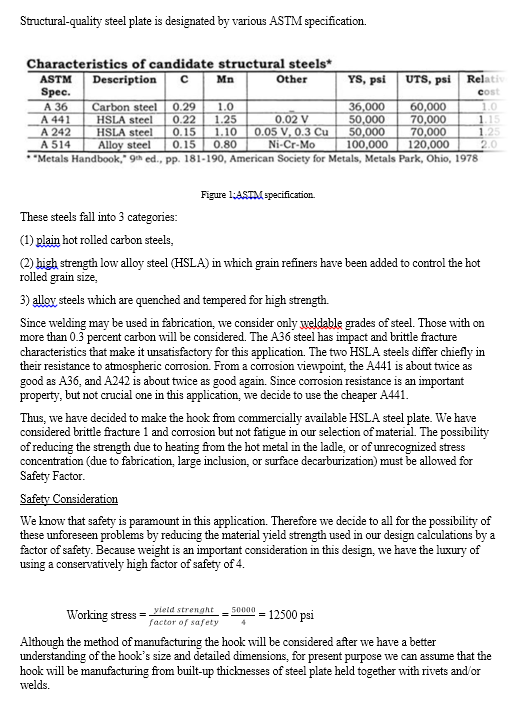
Thursday, November 26, 2015
Thursday, November 12, 2015
ASSIGNMENT 7, CHAPTER 7
Assignment 7.6
Four concepts for improving the design of an on/off switch
in a right-angle drill are sketched in the figure below. Determine a set of
criteria for an on/off switch. Use this in-formation to prepare a Pugh chart
and select the best option from the given alternatives. Concept A is modest
change to the existing switch, and will be the DATUM. Concept B adds three
buttons for on/off/ and reverse. Concept C is a track and slider design, and D
is an add-on accessory to make it easier to operate the existing switch.
a) Enlargement
of existing switch
b) Multiple
switch design
c) Track
and slider switch design
d) Accessory
add-on to existing switch
Sunday, November 8, 2015
ASSIGNMENT 6, CHAPTER 6
Assignment 6.6
Sunday, November 1, 2015
Saturday, October 31, 2015
ASSINGMENT 5, CHAPTER 5
5.5) Where you would find
the following information?
a) The services of
taxidermist
b) A
consultant of carbon fibre reinforced composite materials
c) The price of X3427
semiconductor chips
d) The melting
point of osmium
e) The proper
hardening treatment for AISI 4320 steel
a) The services of
taxidermist
The information of
services of taxidermist can be found by:
1. Search
engine such as Google or Yahoo that lead to the website:
·
http://www.taxidermy.net/
·
https://en.wikipedia.org/wiki/Taxidermy
2.
Journal from the scholar that study about taxidermy :
·
Henning, Michelle
(2007). "Anthropomorphic taxidermy and
the death of nature: The curious art of Hermann Ploucquet, Walter Potter
and Charles Waterton."
3. Newspaper
and articles that discuss about the services of taxidermy :
·
Topcik, Joel. "Head of
Goat, Tail of Fish, More Than a Touch of Weirdness". The
New York Times January 3, 2005. Page 2.
·
Charles Johnson Maynard “manual
of taxidermy for amateurs a complete guide in collecting and preserving birds
and animals”
b) A consultant
of carbon fibre reinforced composite materials
1. Searching from website.
Example of website which is available for
getting more information about carbon fibre is www.carbonfibrereinforcedcomposite.com.uk
2. The researches, consultancies, training and information are available from
net composite website as well.
3. The technology of carbon fibre reinforced composite material is available
for research, development, prototyping and testing of innovation composite
material and their associated manufacturing technologies in our 700 square
metre development centre.
4. From the insight view of conferences, it can be done by training course,
conferences, seminar and workshop on a broad range of composites topics.
5. In addition some journals also provides
access to a wealth of composites information including technology guides, the
latest industry news, an events calendar, a glossary, an industry directory and
jobs listings.
c)
The price of X3427 semiconductor chips
1.
Internet for
example google.com search engines.
2.
Contact with
suppliers and vendors.
3.
Contact with
consultants.
4.
Attendance to
conferences, trade shows and exhibition.
5.
Visit to other
companies.
Example of
price of X3427 semiconductor chips:
·
X3427
Chip Availability & Rapid Quote Request http://www.1sourcecomponents.com/partinfo/x3427%20cHIP.htm
·
Semiconductor
Datasheet Parts http://www.digchip.com/datasheets/parts/q6/parts_q603.php
d) The melting
point of osmium
Example of website
and book that provide the the melting point of osmium information :
·
Handbook of
Inorganic Compounds, Second Edition, By Dale L. Perry
·
www.webelements.com/osmium/
Figure of osmium crystal
e) The proper
hardening treatment for AISI 4320 steel
There are certain
ways to find ways for proper hardening treatment for AISI 4320 steel which are
:
1.
from the website and also from any access to digital database.
2.
Consultant from any companies that provide information about the treatment.
3.
Source from libraries that provide engineering books and also journal about
engineering knowledge.
4.
The information may come from the network of professional friend and aided by
email as communication medium.
Example
of website that provides the treatment information :
Example of books/
journals that may provide the hardening treatment :
· Heat
Treating Progress: The Official Voice of the ASM Heat Treating Society, Volume 2, Issues 4-9
·
Gear
Materials, Properties, and Manufacture, Joseph R. Davis ASM International, 2005.
Figure of AISI 4320 steel
Sunday, October 18, 2015
ASSIGNMENT #3, CHAPTER 3
3.9) A product design team is designing an
improved flip-lid trash can such as that which would be found in a family
kitchen. The problem statement is as follows:
Design a user-friendly, durable, flip-lid can that opens
and closes reliably. The trash can must be lightweight yet tip-resistant. It must
combat odor, fit standard kitchen trash bags, and be safe for all users in a
family environment.
With this information, and a
little research and imagination where needed, construct a House of Quality
(HOQ) for this design project.
Monday, October 12, 2015
ASSINGMENT #2, CHAPTER 2,
2.9 List the key steps in the technology
transfer (diffusion) process. What are some of the factors make technology
transfer difficult? What are the forms in which information can be transferred?
Technology can result
from the application of science to add value, simplification, diversification,
and productivity to a management process or product. However, technology's
value wanes unless it can be transferred to a user who can apply the technology
to create a tangible benefit. Arising from this assertion, the vitality of
public good science funding is critically dependent on technology transfer. Technology transfer appears to be a simple communication process.
However, in-depth analysis reveals a predictable learning pattern whereby,
comprehension of the technology is first achieved, and then comes the
interpretation of how the technology can be used to solve a problem; finally,
the actual application of the technology to solve a problem. Technology
transfer has been employed for centuries as a method to boost technological and
economic development of nations. The
technology transfer process describes the linkages which integrates the
adoption of new science knowledge, and the functional interrelations of the
different specialists within the process. According to Khurana (2013)
technology transfer is the process of disseminating technology (including
knowledge and skills) from the giver to the recipient. Grosse (1996) defines
the process as the process of transferring skills, knowledge, technologies,
methods of manufacturing, samples of manufacturing and facilities among
governments or universities and other institutions to ensure that scientific
and technological developments are accessible to a wider range of users who can
then further develop and exploit the technology into new products, processes,
applications, materials or services.
Technology transfer occurs only when certain conditions are met.
First, there must be two parties at least - someone who wants to acquire the
new technology and another party which is ready to give out the technology.
This means the first condition is that there must be a supplier and an acquirer
of the said technology. The second condition is about the willingness of the
technology owner to release it. Technology seekers may work hard to search for
the appropriate technologies; but these efforts may become futile, if
technology owners are reluctant to give those technologies to other parties.
The supplier may be reluctant due to fear of competition, due to security
reasons, or because the technology might not be mature enough for releasing
out. The third condition lies in the degree of the desire of the technology
seeker. Regardless whether transfer process occurs internally or externally,
there is one key factor driving the technology recipient to employ technology transfer
as a development strategy. This factor is called technology user acceptance.
Technology transfer can be described as market pull or technology
push. Market pull occurs when expressed needs or problems cause private
companies to seek technology from elsewhere. In contrast, technology push
occurs when acquired innovations or inventions are used to create new markets
or consumer needs within or outside the given country. Whereas market pull of
technology is demand driven process, technology push is supply driven. Sometimes,
the push and pull forces complement each other, reinforcing the pace of
technology transfer. In brief, there is a distinction between technology push
and market pull or demand. A technology push implies that a new invention is
pushed into the market through R&D, production, and sales functions; this
takes place without accurate consideration of whether the pushed technology
will satisfy the user needs or not. In contrast, a market pull occurs when an
innovation is developed by the R&D entity in responding to an identified
market need. So, technology push is a part of a business strategy of a company
to create a market for its technology or products thereof. Many of the so
called ‘international technical aid’ to developing countries from developed
world can be seen as technology push if scrutinized critically.
Several challenges face technology transfer that makes the process
difficult is: incomplete information; market power; and market failures.
Incomplete information is the fact that technology owners do not always
disclose all the information to the recipient; hence the buyer is unable to
fully appreciate the actual price ant the extent of the technology. Owners
would prefer to open subsidiaries than disclosing the whole truth to the
would-be competitors. Regarding market power, owners of technology have more
power than buyers because of their accumulated advantage and the power of
patents and the backing they get from International Bodies. This situation
makes the price of technology often higher than expected; hence giving a smile
to technology owners and pain to buyers. Besides, the market cannot always
appreciate and measure the costs and benefits of technology diffusion. Hence,
technology owners may not gain any benefit that might eventually occur when the
diffused technology produces spillovers. If there are any positive spillover
results, the advantage will go to technology buyer alone.
Another problem is that policy makers and planners may face
difficulty in analyzing, measuring and pricing of complex technology transfer
processes. Together with that challenge is the intricate issue of technology
imitation. Imitation is hardly reported or documented properly; hence, making
the capture of innovation spillover difficult. These measurement challenges
leads to another complication for policy makers of how to formulate adequate
technology transfer targets for the national policies and programs in the
complex technology transfer undertakings. Additional problem lies in the hidden
mismatch between the goals of technology giver and buyer. The capitalist world
adores super profits. Hence, their goal is often to realize as much profit as
possible through whatever form of technology transfer. The poor world is
struggling with solving socioeconomic growth problems. The goal here is to get
technology at cheapest possible price. On the other hand, although a developing
country may pay fully for the technology, the country may end up receiving
outdated or secondhand technology; or it may even suffer from incomplete or
inadequate delivery of technology. Last but not least, in technology transfer
sometimes there exists a problem of separation of knowledge from technology due
to fear of competition. Let it be known that without adequate transfer of
knowledge, transfer of technology alone will not be effective. Both explicit
and hidden knowledge must be transferred to the recipient. In fact, it is often
difficult to get from technology owners the hidden knowledge because it is a
key to a competitive advantage for the technology givers.
Finally, a few forms of the technology transfer are:
(1) Newsletter (2) Technical reports and papers (3) Data sheets. (4) Workshops
and seminars. (5) Internet.
Subscribe to:
Posts (Atom)